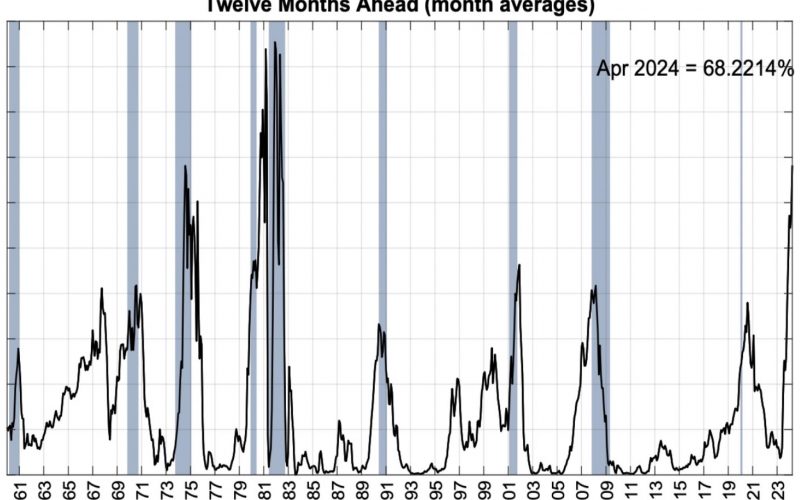
The probability that the U.S. economy will enter a recession within the next year has increased to 68.2% in April.
That’s the greatest level since late 1982, according to the Federal Reserve Bank of New York.
The model employs the U.S. Treasury yield curve, and specifically the spread between three-month and 10-year yields, as a metric for estimating the likelihood of a future recession.
U.S. Recession Probabilities And Wild Yield Curve: What You Need To Know
- Recession probabilities as measured by the Federal Reserve Bank of New York have skyrocketed from nearly 5% in January 2023 to 68.2% in April, the highest level since the end of 1982.
- The move has been sparked by a significant inversion of the U.S. Treasury yield curve, with the 10-year yield falling to over 1.7% versus the three-month yield, the most negative since the 1980s.
- The 10-year versus three-month yield inversion has been a reliable recession predictor, anticipating each of the past eight U.S. economic recessions.
- Concerns around the current state of the economy, the banking turmoil and the growing stress associated to the debt ceiling stalemate have further inverted the US Treasury yield curve over the past weeks, causing recession probabilities to grow substantially.
- A one-month T-Bill, which is the most sensitive to the debt-ceiling frenzy because it is the closest to mature after the June 1st deadline, currently yields 5.68% annualized, compared to a 3.46% yield in the 10-year benchmark, for a difference of over 220 basis points (or 2.2 percentage points), the widest since data began in 2002.
- Chart: New York Fed’s Probability Of A U.S. Recession Within A Year

Source: New York Fed
Most-Popular Exchange Traded Funds (ETFs) Investing In US Treasuries:
- SPDR Bloomberg 1-3 Month T-Bill ETF (NYSE:BIL)
- SPDR Bloomberg 3-12 Month T-Bill ETF (NYSE:BILS)
- iShares 1-3 Year Treasury Bond ETF (NASDAQ:SHY)
- iShares 7-10 Year Treasury Bond ETF (NASDAQ:IEF)
- iShares 20+ Year Treasury Bond ETF (NASDAQ:TLT)
Next: Debt-Limit Standoff: 3 Favorite Hedges For Bond Investors Seeking Shelter From Crisis